The 2026 Tech Marketing Manifesto: Mastering the Digital Frontier
Introduction: The Great Convergence
In 2026, the line between “Tech” and “Marketing” has effectively vanished. We no longer live in a world where marketing simply uses technology; rather, technology is the marketing. The digital landscape has evolved from a series of fragmented channels into a sentient, interconnected ecosystem driven by predictive AI, decentralized platforms, and a radical shift toward user-owned data.
To succeed in this environment, marketers must adopt a “Techno-Marketer” mindset—balancing the cold, hard efficiency of automation with the irreplaceable warmth of human empathy. This blog explores the blueprints for high-velocity growth in the current decade.
Part I: The Architecture of Modern Tech Marketing
1. AI-First Execution: From Tool to Backbone
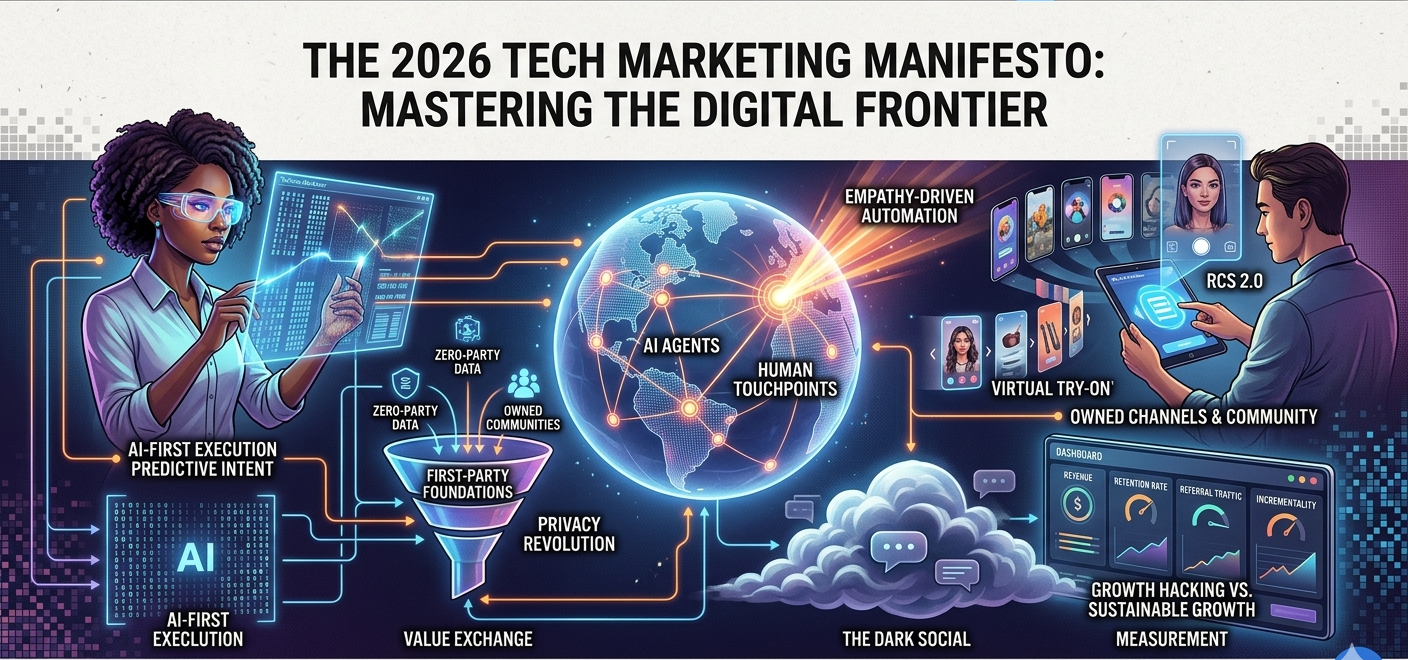
By 2026, AI is no longer a “feature” in a marketing stack; it is the operational backbone. We have moved past basic generative AI for blog posts into Systemic AI Integration.
-
Predictive Intent Engines: Instead of reacting to clicks, tech marketers use AI to forecast customer needs before they manifest. By analyzing “micro-signals” across various touchpoints, brands can trigger hyper-personalized outreach at the exact moment a prospect enters a “consideration” phase.
-
Autonomous Campaign Optimization: The days of manual A/B testing are over. Current systems leverage multivariate testing in real-time, adjusting headlines, imagery, and CTAs for every individual user based on their specific cognitive profile.
2. The Death of the Third-Party Cookie
The “Privacy Revolution” is fully realized. With the total phase-out of third-party cookies, tech marketing has pivoted to Zero-Party Data and First-Party Foundations.
-
The Value Exchange: To get data, you must provide immediate utility. Interactive tools, calculators, and exclusive “owned” communities are the new lead magnets.
-
Privacy-Preserving Computation: Tech brands are now utilizing “Clean Rooms” to collaborate with partners on data without ever exposing personally identifiable information (PII).
Part II: Core Channels & Evolutionary Strategies
3. SEO in the Age of Search Generative Experience (SGE)
Search has fundamentally changed. Users no longer “search”; they “consult.”
-
Topic Authority vs. Keyword Density: Google’s algorithms now prioritize “Information Gain.” To rank, your content must provide new, unique insights that an AI model couldn’t simply scrape from elsewhere.
-
Optimization for Answer Engines: We are optimizing for Perplexity, ChatGPT, and Gemini. This means structured data (Schema) is more vital than ever, ensuring AI agents can accurately parse and cite your brand as a source of truth.
4. The Resurgence of Owned Channels: Email & SMS 2.0
As ad costs on Meta and Google continue to climb, “Renting” audiences has become a luxury. “Owning” them is a necessity.
-
RCS (Rich Communication Services): SMS has “grown up.” RCS allows for app-like experiences directly in the messaging folder—carousels, payments, and booking systems—without the user ever leaving their text thread.
-
Hyper-Segmented Email Workflows: Email is now driven by “Systemic Empathy.” Workflows are no longer linear; they are tree-like structures that branch out based on user sentiment and engagement velocity.
5. Social Media: Community over Reach
In 2026, “Going Viral” is a vanity metric. “Building a Tribe” is the ROI metric.
-
Creator-Led Commerce: The most successful tech brands aren’t posting from their corporate accounts; they are partnering with niche technical influencers who hold the trust of the developer or C-suite community.
-
Short-Form Video as the Documentation: For SaaS and B2B tech, 60-second “How-to” videos on TikTok and Reels have replaced long-form whitepapers for the initial awareness stage.
Part III: The Psychology of 2026 Tech Marketing
6. Growth Hacking vs. Sustainable Growth
The “Growth at all costs” mantra of the 2010s has been replaced by Sustainable Unit Economics.
-
The AAARRR Framework (Revitalized): Awareness, Acquisition, Activation, Retention, Referral, and Revenue. In 2026, the focus has shifted heavily to Retention and Referral.
-
Product-Led Growth (PLG): The product must market itself. In tech, the “Free-to-Paid” conversion path is the ultimate marketing funnel. If the UX is frictionless, the marketing budget can stay lean.
7. Empathy-Driven Automation
As AI interactions become the norm, “Human-ness” is the ultimate premium.
-
The Turing Test of Marketing: If a customer can tell an interaction is automated and it feels cold, you’ve lost. The goal is to use automation to remove friction, but use human touchpoints to build emotional equity.
Part IV: Specialized Tech Marketing Segments
8. B2B Tech Marketing: High Stakes, High Trust
B2B cycles have lengthened due to increased scrutiny on ROI.
-
ABM (Account-Based Marketing) at Scale: AI allows us to run “1-to-1” marketing for thousands of accounts simultaneously. Each decision-maker at a target firm receives content tailored to their specific pain points (e.g., the CTO sees security specs; the CFO sees cost-savings reports).
-
The Rise of the “Dark Social”: Most B2B buying decisions happen in private Slack groups, Discord servers, and DM threads. Savvy tech marketers “seed” these communities by providing value without a pitch.
9. B2C & Consumer Tech: Experience as a Product
-
AR/VR Integration: Augmented Reality is no longer a gimmick. “Virtual Try-ons” for hardware or AR walkthroughs for software setup are standard parts of the customer journey.
-
Gamification: Turning the user journey into a rewarding experience. Progress bars, badges, and community leaderboards are no longer just for apps; they are part of the marketing lifecycle.
Part V: Measurement and the “Search for Truth”
10. Beyond the Last Click: Unified Measurement
Attribution is the “Holy Grail” of 2026.
-
MMM (Marketing Mix Modeling): Since privacy prevents tracking every click, marketers are returning to statistical modeling to understand how offline, social, and search efforts work together.
-
Incrementality Testing: The only question that matters: “Would this sale have happened without this ad?” Tech marketers are constantly running “hold-out” tests to prove the true value of their spend.
Conclusion: The Road Ahead
Tech marketing in 2026 is a discipline of constant adaptation. The tools will change—by next year, we might be marketing to “AI Agents” that shop on behalf of humans—but the core principles of Value, Trust, and Utility remain.
To win, you must be:
-
Data-Informed, but Soul-Led: Let the data tell you what is happening, but let human empathy tell you why.
-
Agile: The ability to pivot your strategy in 24 hours is more valuable than a 5-year plan.
-
Community-Centric: Your customers are your best marketers. Build a product and a brand they are proud to champion.
The future of digital marketing isn’t just about reaching people; it’s about being the solution they didn’t even know they were looking for.
- The Future of Digital Marketing: New Paths to Success with TechMarketing
- In today’s fast-evolving digital era, having an online presence has become essential for every business. This is where digital marketing emerges as a powerful tool. When used with the right strategy, it not only enhances brand awareness but also significantly boosts sales. In this field, TechMarketing has established itself as a prominent name, helping businesses reach new heights through modern skills and creative approaches.
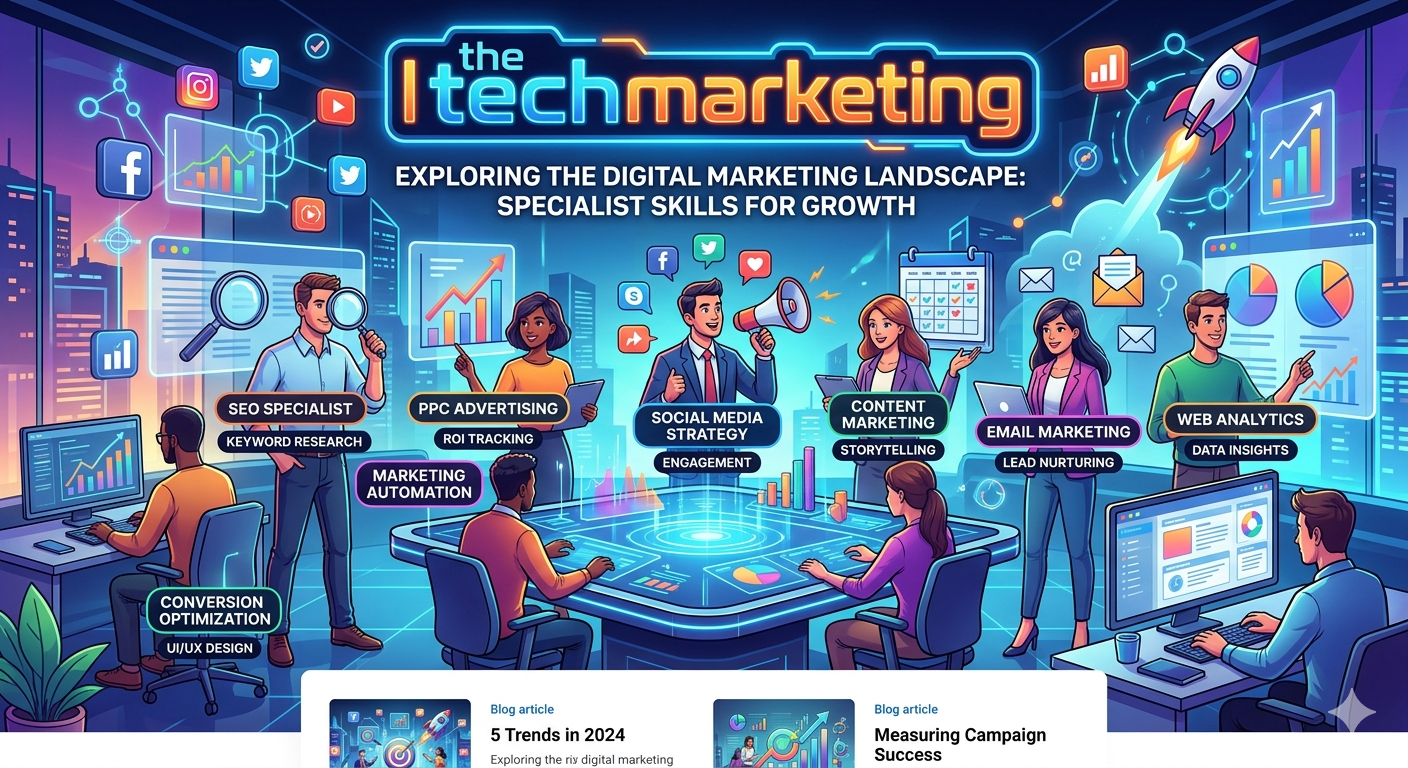
- 1. Social Media Marketing
- Social media has become an integral part of everyone’s life. TechMarketing utilizes these platforms effectively to connect brands with their target audience. Through creative and engaging content on platforms like Facebook, Instagram, LinkedIn, and TikTok, they capture user attention and build strong brand engagement.
- 2. Search Engine Optimization (SEO)
- The success of any website depends largely on how easily it can be found on Google. TechMarketing specializes in advanced SEO techniques that help websites rank higher on search engines, resulting in increased organic traffic.
- 3. Content Marketing
- The principle “Content is King” remains as important as ever. TechMarketing creates unique, informative, and engaging content that not only attracts users but also builds trust in the brand.
- 4. Paid Advertising
- Quick results can be achieved through Google Ads and social media advertising. TechMarketing designs effective ad campaigns that deliver maximum results even with a limited budget.
- 5. Email Marketing
- Email marketing is a powerful way to communicate directly with customers. TechMarketing uses this strategy to strengthen brand loyalty and improve conversion rates.
- 6. Data Analysis & Strategy
- Success in digital marketing depends heavily on the smart use of data. TechMarketing leverages modern tools to analyze data and develop strategies that drive effective results.
- Conclusion
- Digital marketing is no longer just a trend—it has become a necessity. If you want to grow your business, choosing the right partner is crucial. TechMarketing, with its expertise, experience, and creative mindset, is ready to lead your brand toward success.
- Step into the digital world today and start writing your success story with TechMarketing.